

800-385-2243


- Home
- Our Firm
- Attorneys
- Eric Bacaj
- Gregory P. Bailey
- Justin A. Batoff
- Erin D. Brooks
- Hayley Cassedy
- Amy B. Chappell
- Phillip J. Closius
- Mark Edelson
- Renee Gast
- E. Philip Hanlon
- Andrew M. Harvey
- Marshall T. Henslee
- Todd Hesel
- Emily Kamp
- Richard M. Karceski
- Steven N. Leitess
- Michael J. Levin
- Christopher Macchiaroli
- Meredith McKinnon
- Christopher J. Mincher
- Joseph F. Murphy Jr.
- Pierce Murphy
- Cary Murray
- Kurt Nachtman
- Andrew Norman
- Ethan S. Nochumowitz
- Edward P. Parent
- Ira Rainess
- Patrick R. Seidel
- Monica L. Scherer
- Keira Sherper
- Ilona Shparaga
- Steven D. Silverman
- Laura A. Simmons
- Kathleen Hanlon Sinclair
- William Sinclair
- Andrew G. Slutkin
- Andrea L. Smith
- Creston P. Smith
- Kerri L. Smith
- Avery Strachan
- Brian G. Thompson
- Nathan Volke
- Jason Wasserman
- Megan Weaver
- Andrew C. White
- Ramsay M. Whitworth
- Rian Wieser
- Alexander Williams, Jr.
- Joseph R. Woolman, III
- Practice Areas
- Administrative Law & Defense of Professionals
- Appeals - State & Federal
- Baltimore City Liquor Board Processes
- Business Counseling, Litigation & Transactions
- Business Formation
- Contract Litigation
- Asset-Based Lending and Commercial Financing
- Alternative Finance
- Securities
- Business Divorce: Partnership & Shareholder Disputes
- Bankruptcy, Receivership, Insolvency & Creditors’ Rights
- Insurance Law
- Intellectual Property Law
- Employment Litigation & Counseling
- Outside General Counsel Legal Services
- Complex Civil Litigation
- Criminal Defense
- Divorce
- Driving Under the Influence
- Estates, Trusts, Probate & Fiduciary Litigation
- Family Law
- Federal Crimes & White Collar Crimes
- Legal Malpractice
- Medical Malpractice
- Personal Injury
- Real Estate
- Sports, Entertainment & Gaming Law
- Tax Controversy Litigation
- Victim’s Rights
- How We Can Help in an Injury Case
- How We Can Help in a Criminal Case
- Sexual Abuse of Minors
- Suspected Abusers – By Name – Bishop Accountability Only
- Suspected Abusers Named in the Attorney General’s Report
- Alleged Abusers – By Name – Archdiocese Website
- Alleged Abusers in the Archdiocese of Baltimore – Organized by School
- Summary: Maryland Attorney General’s Report on Child Sexual Abuse in the Archdiocese of Baltimore
- Scholarships
- Firm News
- Case Results
- Legal Insights
- Contact
Trusted for Integrity.
Chosen for Results.
Maryland Brachial Plexus Injury Attorneys
Birth Injury Lawyers for Erb's Palsy in Baltimore, MD
There are multiple types of birth injuries that can occur due to medical negligence. Some of these involve nerve injuries affecting the brachial plexus, which can lead to physical disabilities and other health issues. At Silverman Thompson, our attorneys can help families understand how to hold doctors, nurses, and other healthcare providers accountable for injuries that took place during childbirth and recover compensation from medical professionals who did not provide the proper care.
What Is the Brachial Plexus?
The brachial plexus is a complex arrangement of nerve fibers running from the spine, and specifically, the lower four cervical nerve roots (C5, C6, C7, and C8) and first thoracic nerve roots (T1). This network provides motor and sensory innervation to the shoulder, arm, forearm, and hand. These nerves originate in the spinal cord in the neck and travel down the neck into the axilla (armpit region). The brachial plexus includes multiple roots, trunks, divisions, cords, and branches. There are five roots (C5-8 & T1). These five roots merge to form three trunks (superior/upper: C5-6; middle: C7; and inferior/lower: C8-T1). Each trunk then splits into two, to form six divisions (the anterior divisions of the three trunks and the posterior divisions of the three trunks).
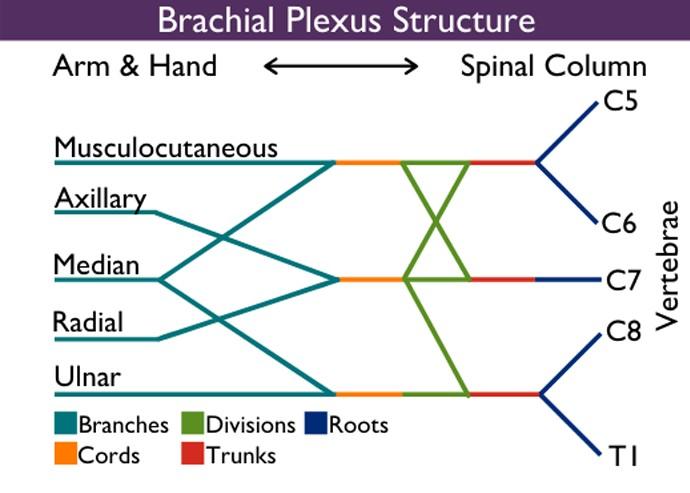
Injuries to one or more of the nerve roots comprising the brachial plexus often occur as a result of excessive traction being placed on the head and neck of a newborn by the OB/GYN during the delivery after the newborn's shoulder has become stuck or impacted behind the mother's pubic bone. This obstetric emergency is more commonly referred to as shoulder dystocia. If excessive force is applied to the newborn's head/neck, the newborn can suffer stretching, compression, or tearing (avulsion) of the brachial plexus nerves. This may occur as a result of medical negligence. The term "avulsion" refers to the forcible tearing away or separation of the nerve root from the spine. That is, the stretching force may lead to the detachment of the nerve roots from the spine.
Nerve root injuries to the brachial plexus can be diagnosed through an X-ray of the neck and shoulder area to identify fractures to the bone or tissue, imaging tests such as an MRI or CT scan, and tests that use needles with electrodes to evaluate the function and activity of nerves. The signs of a nerve root injury to the brachial plexus include loss of sensation in the arm, paralysis, sensory changes, atrophy of the muscles, and the noticeable positioning of the arm hanging down by the baby's side. Typically when there has been a brachial plexus injury, the baby's arm cannot be raised from the side, and the elbow is not flexible, preventing the victim from performing daily functions like typing and throwing. If the injuries to the nerves are limited to "stretching" type damage (mild damage), the injuries may be temporary in nature and resolve with dedicated physical therapy. Some more moderate injuries may require surgery to regain function. In many cases, severe brachial plexus injuries are permanent.
What Is Erb's Palsy?
If the newborn suffers an avulsion (tearing) type injury to one or more of the nerves comprising the brachial plexus, it is likely that the injuries will be permanent, although only a doctor can accurately assess the degree to which a child will be able to use the hand or arm functionally during their lifetime. Paralysis of the arm caused by injury to the arm's main nerves (usually C5-6) is known as Erb's palsy. The most common cause of Erb's palsy is excessive lateral traction (stretching the head and neck in opposite directions) during birth, which usually is associated with shoulder dystocia. In some cases, neurosurgeons may perform procedures that will attempt to repair the nerve root avulsion by grafting a nerve from another part of the body into the torn nerve.
It is recommended that newborns as young as three weeks old afflicted with Erb's palsy receive daily to weekly physical and occupational therapy to help develop muscle strength. In addition, as these newborns grow older (with no improvement by six months), they may be forced to endure painful surgeries on the shoulder, elbow, wrist, and finger to try improving function in those areas. Some children may receive regular Botox injections to help improve shoulder and wrist function.
Despite these therapies, victims of shoulder dystocia/permanent Erb's palsy often require a variety of accommodations, services, and supports throughout their lifetime, the cost of which can be extremely high. Often, the cost of this lifetime of care can be financially ruinous for a family.
Contact Our Baltimore, MD Erb's Palsy Attorneys
Because of the long-lasting impact of brachial plexus injuries, we strongly recommend that parents consult with the medical malpractice team at Silverman Thompson to investigate whether their child's injuries were caused by a medical mistake for which a child may be entitled to a lifetime of compensation and care. Our lawyers routinely work with specialists such as doctors, life care planners, vocational rehabilitation counselors, and economists to ensure that our clients are fairly and adequately compensated for all of the injuries that they have experienced and all of the losses they will suffer from in the future.
When a child has been affected by Erb's palsy due to errors during delivery, a skilled attorney can provide the legal advocacy a family needs to obtain financial compensation that will help to meet the child's ongoing needs. Attorneys Andrew G. Slutkin and Ethan S. Nochumowitz provide effective representation for families in these situations. Contact our Baltimore brachial plexus injury lawyers for a free consultation by calling 410-385-2225.
Contact Us
 The use of the Internet or this form for communication with the firm or any individual member of the firm does not establish an attorney-client relationship. Confidential or time-sensitive information should not be sent through this form.
I have read and understand the Disclaimer and Privacy Policy.


Practice Areas
Practice Areas

Awards + Recognition





Downtown Baltimore
Baltimore, MD 21202 Map + Directions
Washington D.C.
Washington DC 20006
From our offices in Baltimore, Annapolis, Towson, and Washington, D.C., we provide representation for clients throughout the state of Maryland and beyond, including Bel Air, Fallston, Abingdon, White Marsh, Middle River, Parkville, Essex, Rosedale, Perry Hall, Overlea, Carney, Dundalk, Hampton, Lutherville, Timonium, Cockeysville, Phoenix, Reisterstown, Owings Mills, Randallstown, Pikesville, Milford Mill, Woodlawn, Catonsville, Ellicott City, West Friendship, Clarksville, Columbia, Fulton, Elkridge, Brooklyn Park, Linthicum Heights, Ferndale, Glen Burnie, Pasadena, Severn, Severna Park, Arnold, Cape Saint Claire, Edgewater, Crownsville, Crofton, Odenton, Bowie, Laurel, and Snow Hill.
Results listed are not a guarantee or indication of future case results.
 Your Privacy Choices